
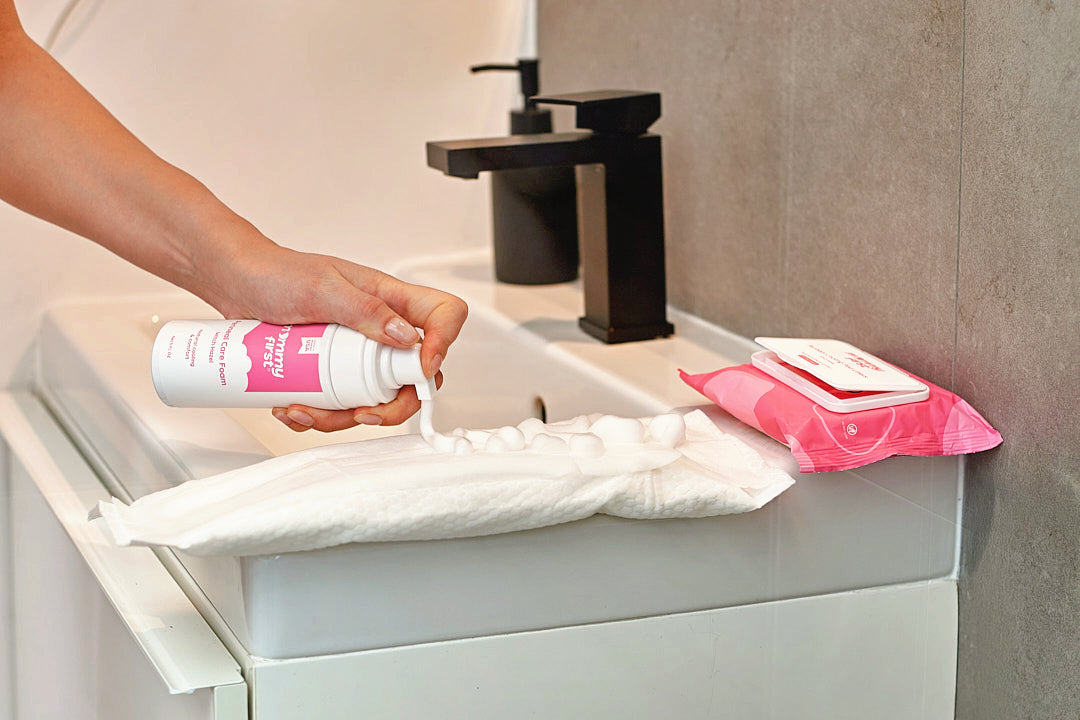
This article explains the science behind alcohol-free postpartum care, probiotic wound support, and microbiome-safe witch hazel formulations.
The $4.6B Industry Paradox — and the Biome-First Engineering Replacing It
-
The Standard: Nearly 90% of first-time mothers experience perineal tearing, yet the standard postpartum treatment relies on alcohol-based sprays.
-
The Science: NIH-published research shows ethanol is cytotoxic, delays wound healing, and damages fibroblasts.
-
The Pivot: Mommy First™ replaced alcohol with probiotics to support healing by restoring the microbiome instead of sterilizing it.
When “Comfort” Becomes a Clinical Contradiction
In any other field of medicine, applying a cytotoxic solvent to an open wound would be unthinkable.
If a patient presented with a Grade 2 laceration on their arm, no clinician would recommend dousing it in ethanol for “cooling.” They would prescribe:
-
Gentle irrigation
-
Moisture balance
-
Barrier protection
-
Support of cellular repair
Yet for postpartum women — many healing complex mucocutaneous injuries — the global standard remains unchanged:
Witch Hazel + 14–20% Alcohol
This is not tradition.
It is a contradiction.
At Mommy First™, we questioned why postpartum care still prioritizes temporary sensation over biological repair — and what it would take to engineer something better.
PART I: THE CLINICAL PROBLEM
1. The Cytotoxicity of “Cooling”
Alcohol is widely used in postpartum sprays for one reason: rapid evaporation.
When ethanol contacts skin, it evaporates quickly, carrying heat away and creating a brief cooling sensation. This sensation is often interpreted as “relief.”
But the biology tells a different story.
The Evidence
Research published by the National Institutes of Health (NIH) and the Journal of Investigative Dermatology demonstrates that acute ethanol exposure is toxic to fibroblasts — the primary cells responsible for wound repair.
The Mechanism
-
Fibroblasts synthesize collagen and extracellular matrix
-
Ethanol denatures proteins and induces apoptosis (cell death)
-
This disrupts epithelialization and delays wound closure
The Outcome
A mother experiences minutes of cooling, but at the cost of:
-
Slower tissue regeneration
-
Increased dehydration of healing tissue
-
Potentially prolonged recovery
In short: alcohol does not heal — it distracts.
2. The “pH Cliff” and Microbiome Instability
Postpartum recovery occurs during a uniquely vulnerable biological window.
Baseline
A healthy vaginal microbiome is acidic (pH 3.8–4.5), dominated by Lactobacillus species that inhibit pathogenic growth.
Post-Birth Reality
Lochia — blood, tissue, and placental remnants — temporarily shifts the environment toward alkalinity (pH ~7.4).
This abrupt transition, which we call the pH Cliff, leaves tissue exposed and susceptible.
The Problem with Alcohol
Alcohol-based products act as non-selective sterilizers, eradicating:
-
Pathogens
-
Beneficial commensal bacteria
-
The very organisms needed to restore the acid mantle
Sterilization may feel “clean,” but biologically, it destabilizes recovery.
PART II: THE BIOME-FIRST SOLUTION
We didn’t set out to make a better spray.
We set out to design a better recovery protocol — one grounded in histology, microbiology, and maternal physiology.
The Biome-Shield Protocol™
1. Retaining the Botanical: Hamamelis virginiana (Witch Hazel)
Witch hazel remains one of the most effective botanicals in postpartum care.
Why It Works
-
Rich in tannins
-
Natural astringent
-
Reduces edema and capillary bleeding
-
Supports tissue tone
The Industry Failure
Historically, witch hazel has been preserved using alcohol — negating its benefits with a damaging solvent.
Our Correction
We use alcohol-free extraction to preserve tannin activity without cytotoxic sting, maintaining anti-inflammatory benefits while protecting healing cells.
2. Eliminating the Toxin: 0% Alcohol
At Mommy First™, we adopted a zero-tolerance policy for cytotoxicity.
What We Changed
-
Removed ethanol entirely
-
Replaced it with a water-based foam matrix
Why Foam Matters
-
Provides gentle cooling via thermal mass
-
Maintains moisture balance
-
Avoids protein denaturation
-
Preserves fibroblast function during the critical first 14 days postpartum
Cooling should never come at the expense of healing.
3. The Active Innovation: Lactobacillus Ferment Lysate
This is where Femtech 2.0 begins.
We shifted from a sterilization model to a colonization model.
Why Probiotics?
Instead of wiping the slate clean, we support the body’s natural defenses by introducing Lactobacillus Ferment Lysate — a probiotic derivative with strong clinical backing.
Mechanisms of Action
Accelerated Repair
Studies published in Cells (2021) show that topical bacterial lysates:
-
Stimulate metalloproteinase-1 production
-
Modulate immune signaling
-
Accelerate wound closure
Competitive Inhibition
Beneficial bacterial metabolites:
-
Occupy surface niches
-
Crowd out opportunistic pathogens
-
Support return to acidic pH balance
This is not masking symptoms.
This is biological cooperation.
PART III: WHY LINERS MATTER AS MUCH AS SPRAYS
Recovery does not happen in isolation.
Our alcohol-free witch hazel foam is engineered to work in tandem with biome-safe liners that:
-
Maintain contact without friction
-
Prevent desiccation
-
Avoid adhesive trauma
-
Support sustained microbiome stability
Postpartum care is a system, not a single product.
Conclusion: From Femtech 1.0 to Femtech 2.0
Femtech 1.0 focused on hardware and commodities.
Femtech 2.0 focuses on biology and restoration.
At Mommy First™, we do not make vague claims about “soothing.”
We engineer for measurable outcomes:
-
Preserved fibroblast activity
-
Stabilized pH
-
Protected microbiome
-
Faster, more dignified healing
True empowerment is dignity.
And true dignity is science.
Selected Clinical References
-
Waitrovich, L. N., et al. “Acute ethanol exposure impairs the proliferative response during healing.” NIH / PMC2774876.
-
Tsai, Y. H., et al. “Heat-Killed Lactobacilli Preparations Promote Healing in Experimental Cutaneous Wounds.” Cells, 2021, 10(11), 3264.
-
O’Hanlon, D. E., et al. “Vaginal pH and Microbicidal Lactic Acid.” PLoS ONE, 2013.
Share:
Postpartum Recovery: The Essential Guide Every New Mom Needs (But No One Talks About)